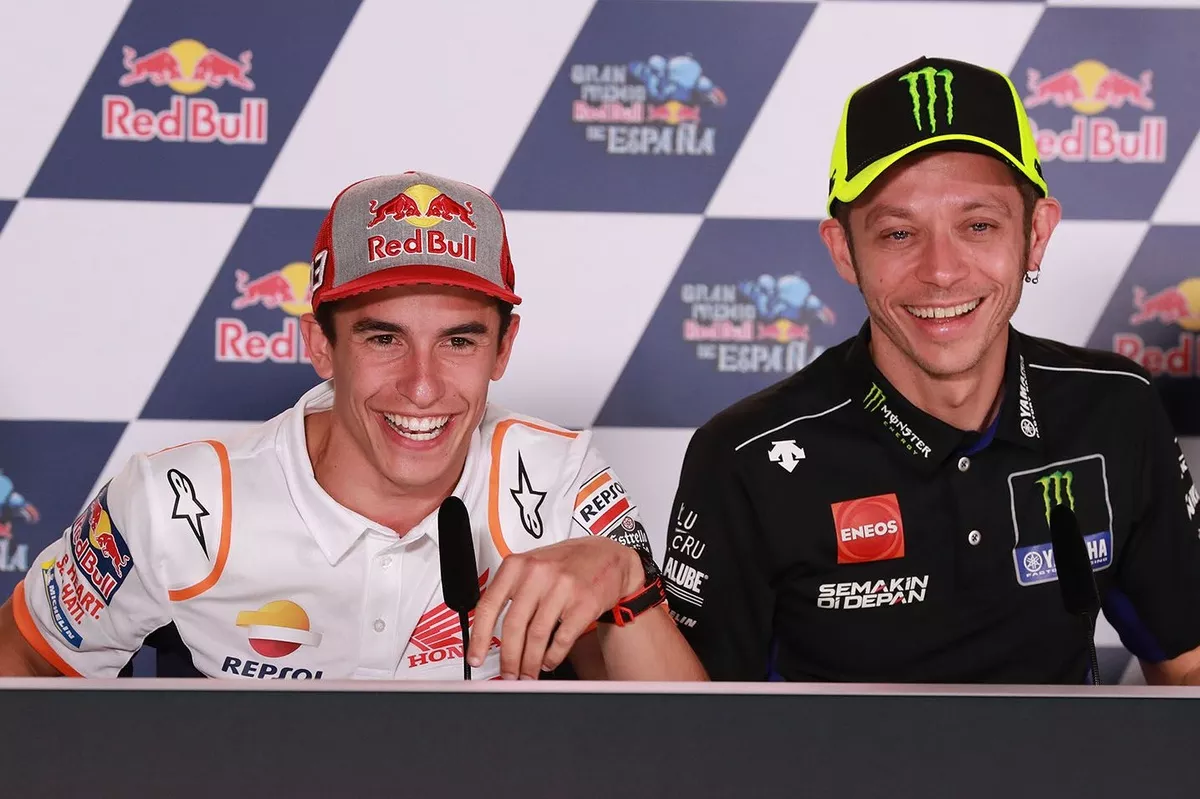
Marc Márquez has publicly addressed his long-standing rivalry with Valentino Rossi, signaling a moment of reflection and maturity that few expected after a decade of tension. In a recent statement, the multiple-time world champion acknowledged the intensity of their past clashes and made it clear that time and experience have reshaped his perspective. His words suggest a desire to move beyond old conflicts and focus on respect rather than resentment.
The rivalry between Márquez and Rossi is one of the most talked-about chapters in MotoGP history. It was fueled by fierce on-track battles, controversial incidents, and passionate fan reactions that often spilled beyond racing itself. For years, the tension defined narratives within the sport, dividing supporters and turning every shared track appearance into a global talking point.
Márquez’s admission reflects how much he has evolved since those heated moments. Early in his career, his aggressive riding style and relentless hunger for victory placed him at the center of controversy. Now, after injuries, comebacks, and seasons of hardship, he appears more introspective, recognizing that rivalries are part of growth rather than something to be carried forever.
Respect, according to Márquez, comes from understanding what rivals contribute to the sport. He has spoken about how competing against legends pushed him to raise his own level, even when emotions ran high. In hindsight, he seems to appreciate that the intensity of those battles helped shape his identity as a champion rather than diminish it.
Valentino Rossi’s influence looms large in this shift of tone. As one of MotoGP’s greatest figures, Rossi represented both an obstacle and an inspiration for younger riders entering the paddock. Márquez’s acknowledgment of respect can be seen as recognition of Rossi’s enduring impact, not just on racing results but on the culture of the sport itself.
Fans have reacted strongly to Márquez’s comments, with many seeing them as a sign of reconciliation, even if no direct personal reunion is implied. For some supporters, the rivalry will always be remembered for its drama, while others welcome the idea that time has softened edges and allowed space for mutual acknowledgment.
The sport itself benefits from moments like this. MotoGP thrives on competition, but it also depends on sportsmanship and legacy. When a rider of Márquez’s stature speaks openly about learning from conflict, it reinforces the idea that greatness is measured not only in titles, but in perspective gained over time.
As the chapter slowly closes, Márquez’s words feel less like an apology and more like acceptance. The rivalry with Rossi may never be forgotten, but it no longer defines him. Instead, it stands as a reminder of an era when passion burned fiercely, shaping careers, captivating fans, and leaving a lasting mark on motorcycle racing history.
About the Author