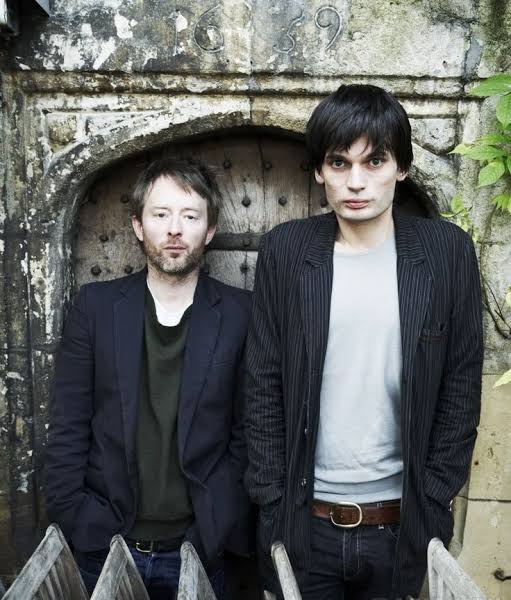
There is something permanently unsteady about Radiohead’s music—as if it’s always on the verge of collapse, yet never quite falling apart. At the heart of that tension live two minds orbiting each other in quiet chaos: Thom Yorke and Jonny Greenwood. One bends emotion until it fractures; the other warps sound until it feels alive, uneasy, and dangerous. Together, they don’t just write songs—they dismantle reality and rebuild it in unfamiliar shapes.From the beginning, Yorke and Greenwood have existed in a strange symbiosis. Thom’s voice arrives fragile, trembling, human—often sounding like it’s pleading with the world to slow down. Jonny answers not with comfort, but with disruption: jagged guitar stabs, dissonant strings, electronic paranoia, rhythms that refuse to sit still. It’s a dialogue built on discomfort, and it’s exactly what makes Radiohead feel so deeply honest.Thom Yorke writes like someone haunted by the future. His lyrics are filled with modern anxieties—surveillance, alienation, environmental dread, the slow erasure of identity in a hyperconnected world. He doesn’t scream these fears; he mutters them, dissolves them into falsetto confessions that sound as if they might vanish mid-sentence. There is vulnerability in his delivery, but also a quiet defiance—an insistence on feeling deeply even when the world seems designed to numb you.Jonny Greenwood, on the other hand, treats sound like a nervous system. His approach to music is restless, experimental, and often deliberately uncomfortable. Classical strings collide with distorted guitars. Radio bleeps bleed into orchestral swells. Time signatures bend and snap. Greenwood’s compositions feel like controlled panic—beautiful, but never safe. He’s not interested in polish; he’s interested in tension, in the moment just before something breaks.Their collaboration reaches its most haunting form when neither artist dominates. On OK Computer, paranoia becomes melody. On Kid A, humanity dissolves into machines. On In Rainbows, intimacy feels exposed and dangerous, as if love itself is a risk. Yorke’s emotional rawness and Greenwood’s sonic instability feed each other, creating music that feels less like performance and more like confession through noise.What makes their partnership so compelling is that it’s never comfortable. They challenge each other constantly, pushing songs into places that feel unresolved, unfinished, or emotionally unsafe. Silence is used as a weapon. Dissonance is allowed to linger. Beauty is always slightly corrupted, slightly bent—like a photograph left too long in the sun.Outside of Radiohead, their creative paths continue to reflect this duality. Yorke’s solo work and side projects explore rhythm, movement, and political unease, while Greenwood’s film scores dive deeper into dread, restraint, and psychological weight. Even apart, they echo each other—proof that their artistic bond goes deeper than any single band or album.Broken Strings & Bent Realities isn’t just a metaphor for their music—it’s the blueprint. Yorke breaks the voice open, exposing fear, love, and existential exhaustion. Greenwood bends reality itself, reshaping sound until it feels unfamiliar and alive. Together, they remind us that art doesn’t have to comfort us to be beautiful. Sometimes, it has to unsettle us first.In a world obsessed with perfection, Thom Yorke and Jonny Greenwood chose ruin—and somehow, in that ruin, they found truth.
About the Author