The announcement of Radiohead’s comeback global tour has landed like a quiet thunderclap, sending ripples through fans who have lived with their music as a constant, evolving presence rather than a fleeting trend. This is not a return built on nostalgia alone, but one shaped by time, distance, and the band’s continued relevance in a world that has finally caught up to many of their long-held anxieties. The anticipation feels different this time—less frantic, more reverent.
For years, Radiohead have existed in a space where absence never meant disappearance. Each member’s solo work, side projects, and subtle hints kept the band’s spirit alive, even as a full-scale reunion felt increasingly unlikely. That slow burn has only deepened the emotional weight of this tour, transforming it into something closer to a cultural moment than a standard run of concerts.
What makes this comeback resonate so deeply is how naturally it aligns with the band’s identity. Radiohead have never rushed toward the spotlight, and this return feels measured and intentional, as if the music itself demanded to be played live again. There’s a sense that this tour isn’t about reclaiming dominance, but about reconnecting—with each other, with audiences, and with songs that have aged alongside their listeners.
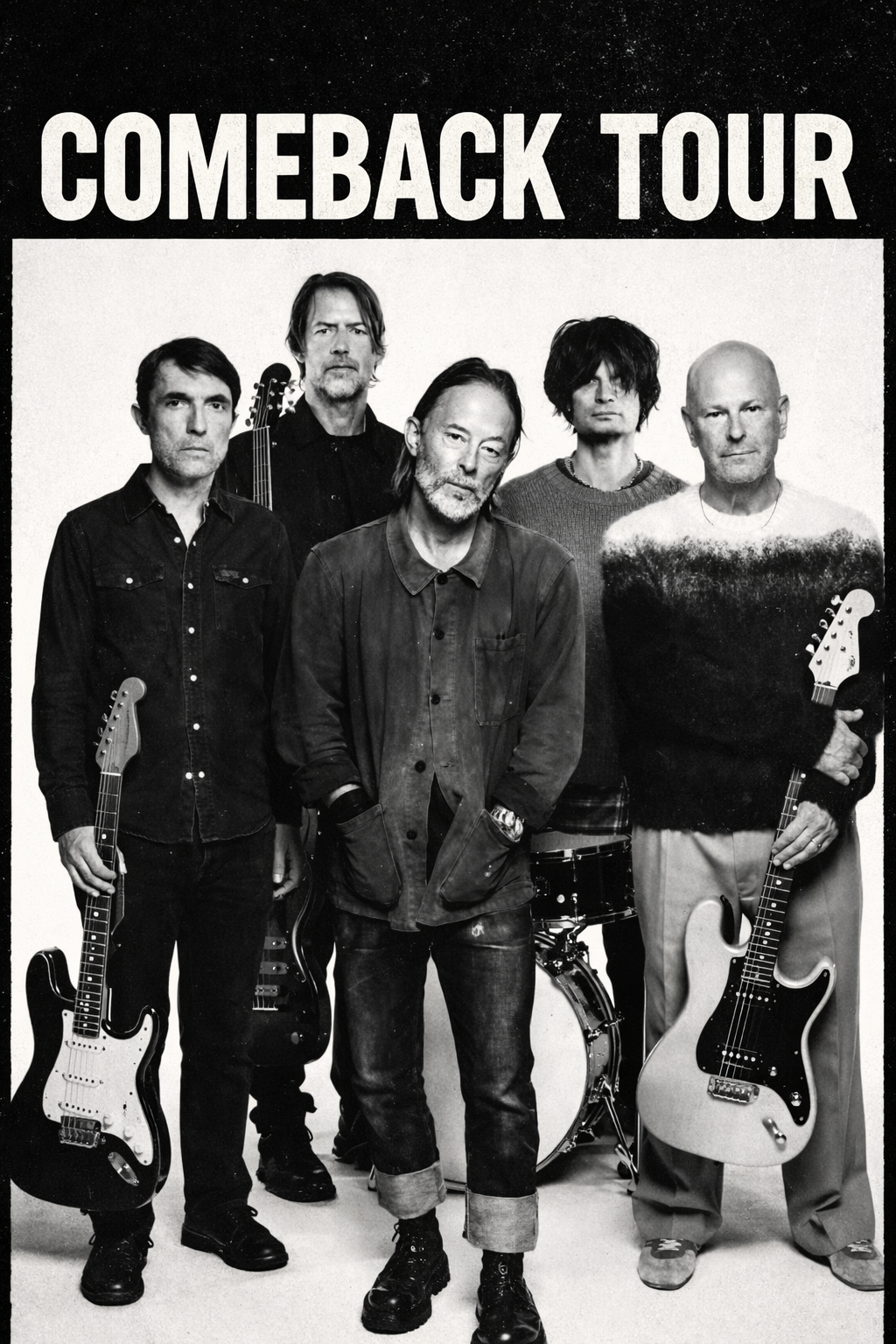
Visually, the tour imagery reflects that philosophy. Stark, monochrome aesthetics dominate, with instruments integrated into portraits rather than staged theatrically. Guitars hang low, drums sit quietly in the background, and the band stands together with a calm confidence that suggests they have nothing left to prove. It’s a powerful contrast to the bombast that often defines comeback tours.
Musically, expectations are deliberately undefined. Fans speculate about setlists that could span decades, weaving early urgency with later experimentation. Radiohead’s catalog lends itself to reinvention, and live performances have always been where songs mutate, stretch, and reveal new emotional textures. The promise isn’t familiarity—it’s transformation.
There’s also an unspoken understanding that this tour reflects the world as it is now. The themes Radiohead explored years ago—alienation, technological unease, emotional dislocation—feel less abstract and more lived-in today. Hearing those ideas echoed in massive venues across continents gives the tour a strange, sobering relevance.
Unlike typical global tours, this one carries an intimacy beneath its scale. Even in large arenas, Radiohead’s performances have historically felt inward-looking, almost private. That paradox is part of their enduring power: making tens of thousands of people feel like they’re sharing something fragile and personal.
The band’s collective presence onstage is expected to be understated yet commanding. There’s no need for spectacle when the songs themselves carry such weight. Small gestures, subtle glances, and long instrumental passages often speak louder than any elaborate production, reinforcing the sense that this tour is about substance over noise.
For longtime fans, the comeback feels like meeting an old friend after years apart and realizing the connection never faded—it simply evolved. For newer listeners, it’s a rare opportunity to experience a band whose live performances have shaped modern alternative music in profound ways. The tour bridges generations without pandering to any of them.
The official announcement confirmed that the tour will begin on June 15, 2026, a date that has already taken on symbolic significance for fans counting down the days. It marks not just a return to the stage, but the start of a new chapter defined by reflection rather than reinvention for its own sake.
As the tour moves across continents, it’s likely to feel less like a victory lap and more like a shared journey. Radiohead have always thrived in the spaces between certainty and doubt, and this global run seems poised to explore that tension in real time, night after night.
In the end, the Radiohead comeback tour isn’t about reclaiming the past—it’s about acknowledging it, carrying it forward, and letting it resonate in a present that feels increasingly aligned with their voice. For a band that has always existed slightly ahead of its time, this return feels not late, but precisely right.
About the Author