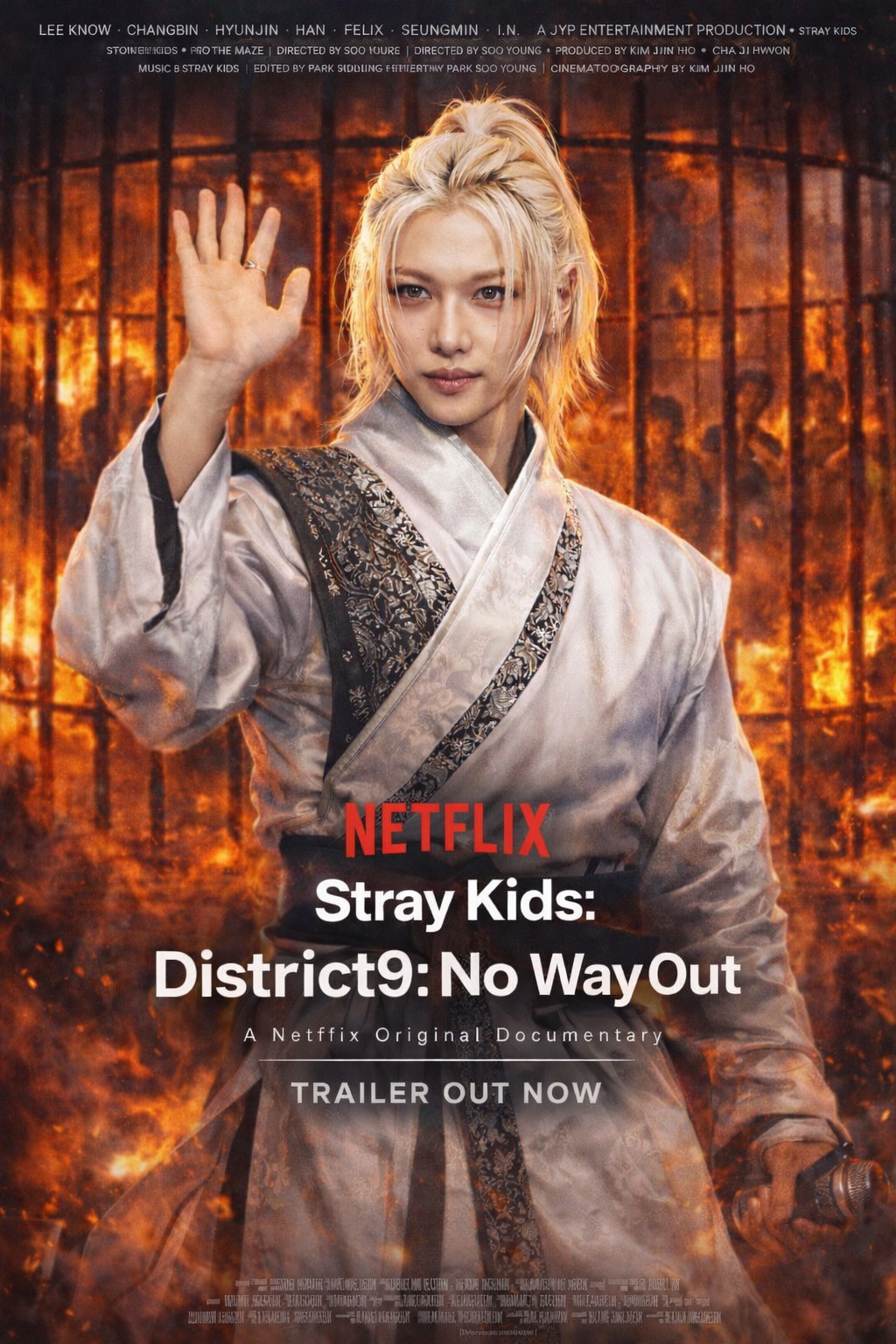
Stray Kids: District 9: No Way Out lands on Netflix as a bold and aggressive reimagining of the group’s origin myth, transforming their debut-era symbolism into a full-scale cinematic experience. From the very first scene, the film establishes a harsh, controlled environment where freedom is restricted and individuality is treated as a threat, immediately pulling viewers into its dystopian world.
The story centers on District 9, a sealed zone designed to suppress creativity and enforce obedience. Within its walls, Stray Kids are portrayed as outcasts who refuse to conform, using sound and movement as acts of resistance. The district itself feels alive, oppressive, and watchful, reinforcing the idea that escape is nearly impossible.
Rather than following a traditional hero’s journey, the movie unfolds as a collective struggle. Each member represents a different response to confinement—anger, fear, defiance, doubt, and hope—all colliding as they attempt to break free. This layered approach gives emotional depth to the rebellion, making it feel earned rather than performative.
Visually, District 9: No Way Out is gritty and industrial, filled with concrete corridors, surveillance lights, and mechanical structures. The color palette is cold and muted, broken only by moments of explosive movement and sound. The cinematography emphasizes confinement, frequently framing the characters behind bars, walls, and narrow spaces.
Music plays a central role, but it is integrated into the narrative rather than presented as standalone performances. Beats echo through hallways like alarms, and lyrics feel like coded messages shared among the characters. The sound design heightens tension, making every rhythm feel dangerous and necessary.
Emotionally, the film taps into themes of isolation and identity. The characters are not just fighting an external system, but also internal doubts about whether escape is even possible. These quieter moments add gravity to the chaos, reminding viewers that rebellion often begins as an internal decision.
The pacing is relentless, mirroring the urgency of the characters’ situation. Chase sequences, confrontations, and moments of near-capture keep the tension high, while brief pauses allow the audience to understand what is at stake. The balance between action and reflection keeps the story engaging throughout.
One of the film’s strongest elements is its sense of unity. While individual struggles are highlighted, the narrative repeatedly emphasizes that survival is only possible together. Trust becomes a weapon, and solidarity becomes the key to resisting a system designed to divide.
District 9: No Way Out also serves as a commentary on control and conformity in modern society. Though set in a fictional world, its themes resonate strongly with real-life pressures to fit into rigid systems. The film invites viewers to question who sets the rules and who benefits from silence.
As of January 28, 2026, the movie has generated intense discussion among fans and new viewers alike, many praising its raw energy and unapologetic message. The date marks a moment where Stray Kids’ original narrative feels more relevant than ever in a global climate of uncertainty and change.
Netflix’s production backing elevates the film without diluting its raw edge. High-quality visuals, sharp editing, and immersive sound design give District 9: No Way Out the feel of a major release while preserving its underground spirit. It feels both polished and rebellious.
By the end, Stray Kids: District 9: No Way Out stands as more than a music-driven film—it is a declaration. It captures the frustration of being trapped, the fear of resistance, and the power of choosing freedom anyway. The movie leaves viewers with a lingering sense that no system is truly unbreakable once voices unite.
About the Author