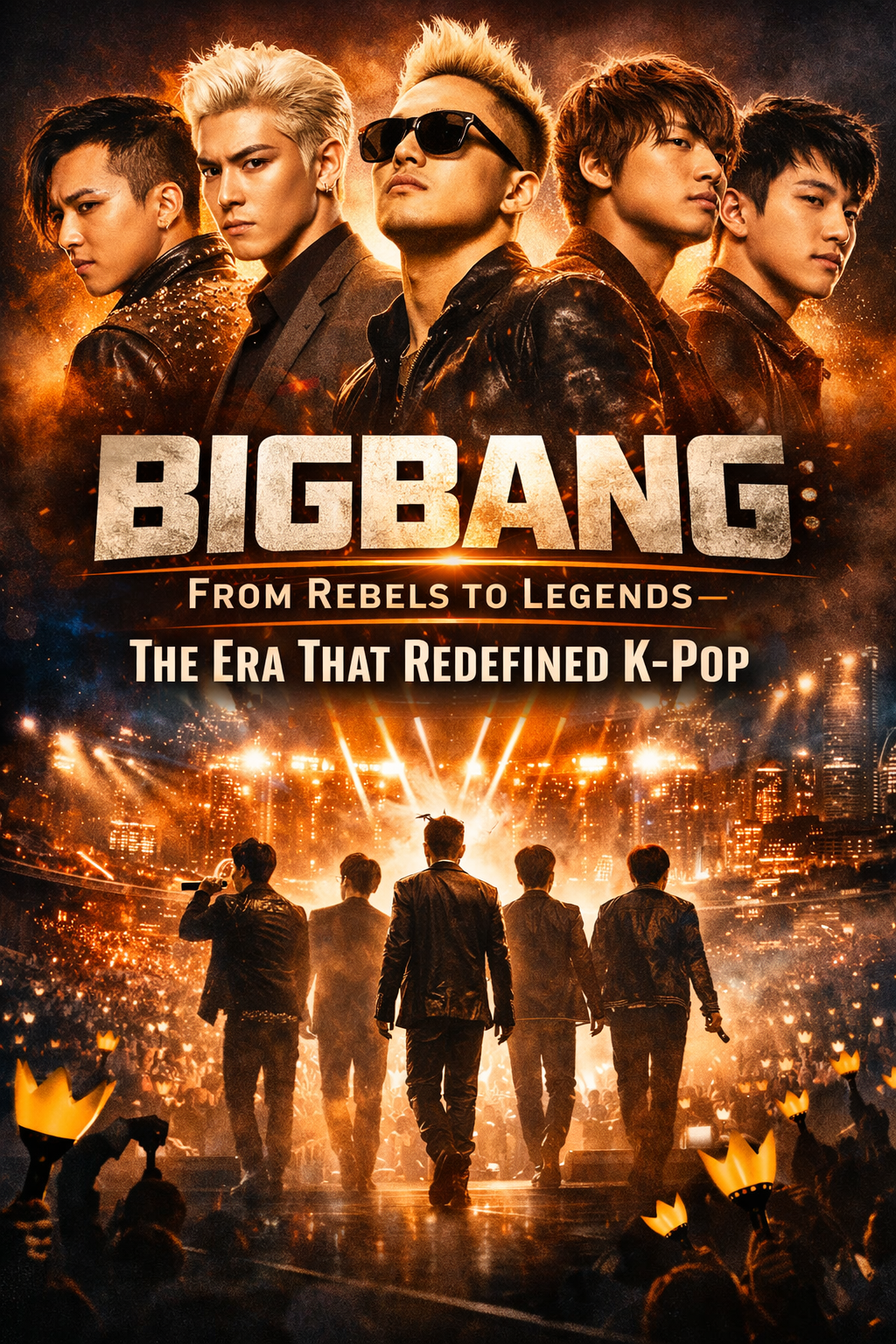
BIGBANG: From Rebels to Legends—The Era That Redefined K-Pop
BIGBANG did not enter the K-pop scene to blend in—they arrived to disrupt it. At a time when the industry leaned heavily on polished perfection and rigid formulas, BIGBANG introduced something raw, unpredictable, and deeply personal. Their debut marked the beginning of a shift that would change not only how idols sounded, but how they were perceived as artists.
In their early years, BIGBANG stood out as rebels. Their music carried influences from hip-hop, R&B, and electronic sounds that felt unconventional for mainstream Korean pop at the time. They weren’t just performers following instructions; they were contributors, creators, and storytellers with something to say. That creative involvement set them apart and laid the foundation for a new kind of idol group.
What truly redefined K-pop was BIGBANG’s authenticity. Their lyrics explored confidence, ambition, heartbreak, excess, and self-reflection—topics that felt honest and sometimes uncomfortably real. Fans didn’t just listen to their songs; they connected to them. BIGBANG made it acceptable for idols to be flawed, expressive, and human.
Their stage presence became legendary. BIGBANG concerts were not just performances but experiences—charged with energy, individuality, and charisma. Each member brought a distinct identity, yet together they formed a balance that felt powerful and effortless. This individuality within unity became a model many groups would later adopt.
Fashion was another battlefield they conquered. BIGBANG blurred the lines between music and style, turning airport looks, stage outfits, and music videos into global fashion moments. They proved that idols could be trendsetters rather than trend followers, influencing both streetwear and high fashion across Asia and beyond.
As their popularity grew, so did their global impact. BIGBANG was among the first K-pop groups to successfully push into international markets, drawing attention from fans who had never engaged with Korean music before. They helped lay the groundwork for K-pop’s worldwide expansion, long before it became a global phenomenon.
Their discography tells the story of evolution. From explosive anthems to introspective ballads, BIGBANG never stayed in one lane. Each era felt like a reinvention, showing growth not just in sound but in perspective. This willingness to evolve kept their music relevant across generations of listeners.
BIGBANG’s influence can be seen clearly in today’s K-pop landscape. Artist involvement in songwriting, genre experimentation, bold visual concepts, and strong personal branding—all of these have become industry standards, largely because BIGBANG proved they could work. They didn’t just succeed; they changed expectations.
Of course, their journey was not without controversy and hardship. Public scrutiny, personal struggles, and long periods of silence tested both the group and their fans. Yet even in absence, their impact never faded. BIGBANG remained a reference point—a benchmark for greatness.
What makes BIGBANG legendary is not just their achievements, but their endurance. Trends came and went, generations shifted, but their music continued to resonate. They became more than idols; they became a cultural era, one that defined what K-pop could be at its boldest.
From rebels challenging the system to legends who reshaped it, BIGBANG’s story is one of transformation and influence. Their era did not simply pass—it redefined K-pop’s identity and opened doors that can never be closed again.
In the history of K-pop, some names are remembered for success. BIGBANG is remembered for revolution.
About the Author