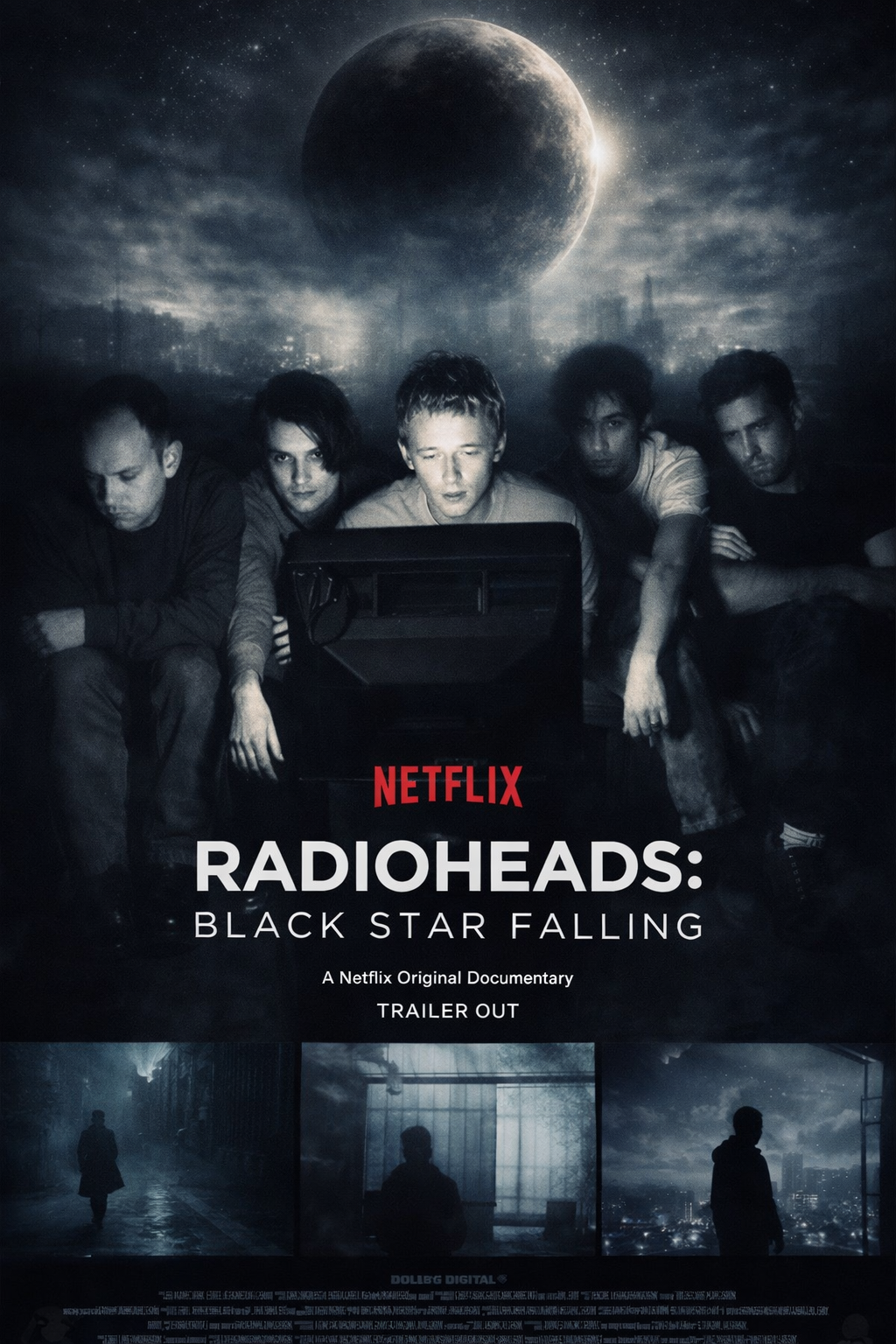
Radioheads; Black Star Falling lands on Netflix with a sense of quiet dread, unfolding like a slow eclipse rather than a sudden explosion. From its opening frames, the film signals that this is not a conventional music documentary or narrative feature, but something more abstract and emotionally demanding. It invites the viewer into a world shaped by unease, beauty, and the weight of unseen forces.
The film weaves together performance footage, archival fragments, and stylized reenactments to create a story that feels both intimate and cosmic. Rather than focusing on fame or chronology, it centers on collapse—personal, societal, and emotional. The idea of the “black star” becomes a metaphor for moments when light bends inward and certainty disappears.
Visually, the movie leans heavily into shadow and contrast. Blacks are deep and consuming, while light appears fragile, almost temporary. Cityscapes feel emptied of warmth, and natural environments are presented as vast and indifferent. Every frame seems designed to remind the viewer how small human emotion can feel against the scale of time and space.
Sound plays an equally powerful role. Instead of relying on full performances, the film often isolates fragments of songs, breaths, static, and ambient noise. These elements bleed into one another, creating a sense of instability. Silence is used deliberately, forcing the audience to sit with discomfort rather than escape it.
The emotional core of Black Star Falling lies in its exploration of fear—fear of failure, irrelevance, loss, and transformation. The film suggests that creativity often emerges not from clarity, but from collapse. Moments of vulnerability are not explained or justified; they are simply presented, raw and unresolved.
Narratively, the film resists a clear arc. It circles its themes repeatedly, each time revealing a slightly different angle. This repetition mirrors the way anxiety and doubt behave in real life, returning even when we believe we have moved past them. The structure may feel disorienting, but it is intentional and effective.
There is also a political undercurrent running beneath the personal stories. Images of unrest, surveillance, and environmental decay appear quietly, never preached, but always present. The film connects internal breakdowns with external ones, implying that personal despair does not exist in isolation.
Despite its heaviness, the movie is not without moments of strange beauty. A lingering shot of light breaking through clouds, a melody barely holding together, or a human voice cracking at the right moment offers brief relief. These moments feel earned precisely because they are so rare.
The pacing is slow and contemplative, demanding attention rather than consumption. This is not a film designed for distraction or casual viewing. It asks the audience to engage fully, to sit with its discomfort, and to find meaning in fragments rather than conclusions.
When Radioheads; Black Star Falling premiered on Netflix on February 3, 2026, reactions were sharply divided. Some viewers praised it as fearless and profound, while others dismissed it as bleak and inaccessible. That split response feels fitting for a film that refuses to comfort or reassure.
As the film moves toward its final moments, it does not resolve its central metaphor. The black star does not disappear, nor does it fully consume everything. Instead, it hangs there—heavy, distant, and unavoidable—leaving the viewer to decide what it represents in their own life.
Ultimately, Radioheads; Black Star Falling is a meditation rather than a statement. It is less interested in telling you what to feel and more interested in reminding you that darkness, uncertainty, and fear are part of the human experience. Like a star collapsing inward, the film draws you closer, not to offer answers, but to make you feel the gravity of the questions.
About the Author
