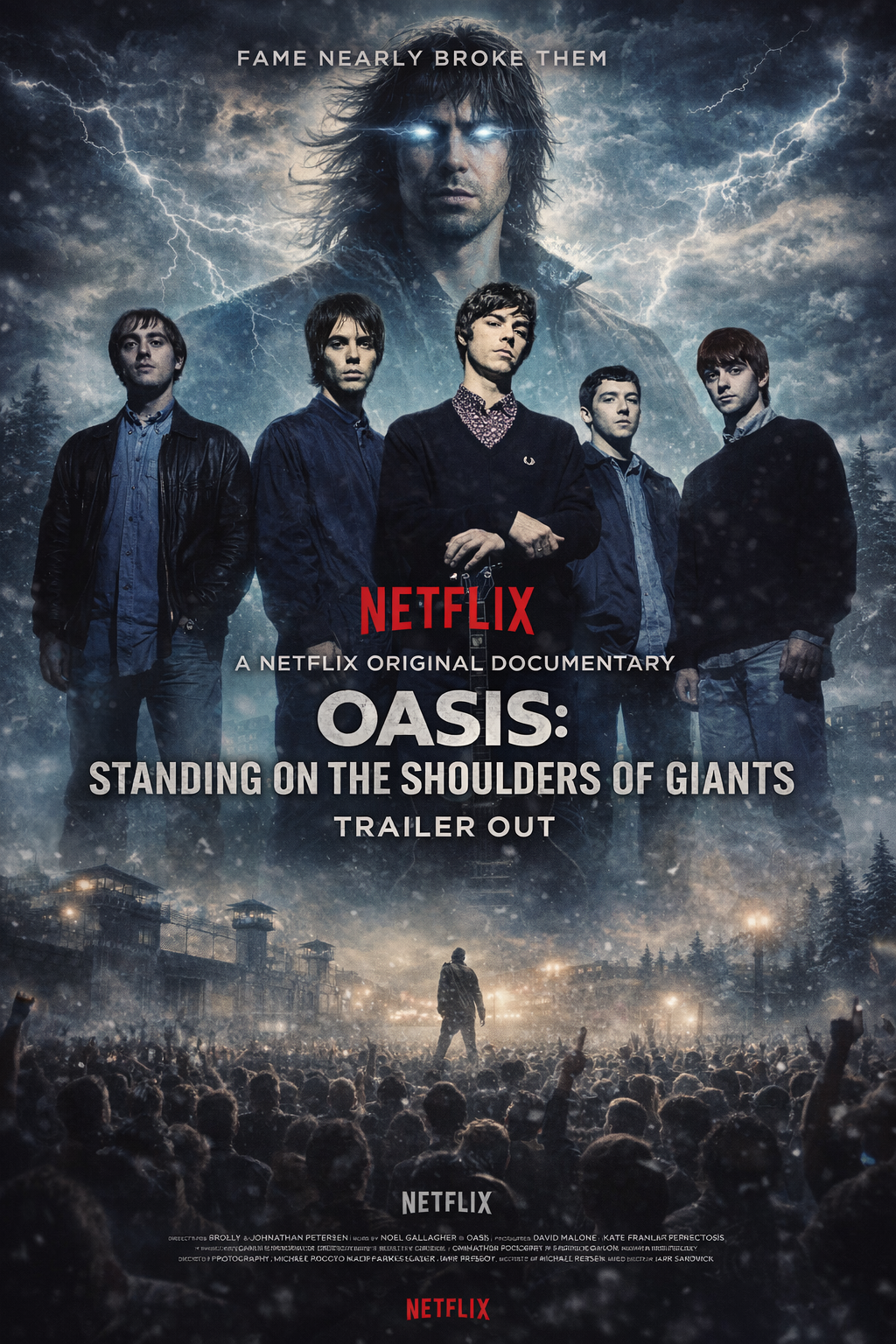
Oasis: Standing on the Shoulders of Giants arrives on Netflix as a reflective and emotionally charged exploration of a band caught between legacy and implosion. Unlike louder, more confrontational portraits of Oasis, this documentary leans into introspection, examining a period when success had already been secured but certainty had begun to crumble. From its opening moments, the film signals a shift in tone, focusing less on conquest and more on consequence.
The documentary situates viewers at a crossroads in Oasis history, when global fame no longer felt like victory but obligation. The band is portrayed as carrying the weight of its own myth, struggling to live up to expectations forged by earlier triumphs. Interviews and archival footage reveal a group aware that they were standing atop something enormous, yet unsure of how long it could hold.
Creative tension is a central theme, as the film explores how inspiration changed once survival was no longer the driving force. Songwriting becomes more isolated, experimentation more pronounced, and collaboration increasingly strained. The documentary suggests that success didn’t dull ambition, but it did complicate it, forcing the band to question what authenticity meant at that level of fame.
Visually, the film adopts a colder, more subdued aesthetic, mirroring the emotional distance within the group. Studio sessions are quiet and tense, while live performances carry an edge that feels more defensive than celebratory. The crowd is still there, the anthems still land, but something intangible has shifted beneath the surface.
Standing on the Shoulders of Giants also examines the toll of internal change. Lineup shifts and personal struggles are treated with sensitivity, not as scandal but as symptoms of deeper instability. The film acknowledges how fragile momentum can be when trust erodes and communication breaks down, even among those bound by shared history.
One of the documentary’s strengths lies in its honesty about doubt. Rather than framing uncertainty as weakness, the film presents it as an inevitable part of artistic evolution. Moments of hesitation, frustration, and reinvention are allowed to breathe, giving the audience a clearer understanding of the pressures that accompany longevity.
The cultural context surrounding the band is subtly woven into the narrative. Britpop’s dominance is fading, tastes are shifting, and Oasis finds itself no longer leading a movement but responding to one. This shift adds a layer of vulnerability, positioning the band as artists navigating relevance in a changing musical landscape.
As the documentary progresses, the emotional distance between band members becomes more pronounced. Conversations feel guarded, silences heavier, and collaboration increasingly transactional. The film resists dramatization, allowing the slow unraveling to speak for itself, which makes the tension feel more real and unsettling.
Despite the strain, the documentary never loses sight of the music. Tracks from the era are revisited with fresh context, revealing depth and experimentation often overshadowed by earlier hits. The film argues, quietly but convincingly, that this period was less about decline and more about transformation.
Released on June 10, 2026, Oasis: Standing on the Shoulders of Giants arrives as a timely reassessment of a misunderstood chapter. The date underscores Netflix’s intent to spotlight nuance over mythology, inviting audiences to listen differently and look deeper.
By the final act, the documentary settles into a tone of acceptance rather than resolution. There are no grand statements or reconciliations, only an acknowledgment of what was gained and what was lost. The film suggests that legacy is not built solely on peaks, but on the courage to continue through uncertainty.
Oasis: Standing on the Shoulders of Giants stands as a thoughtful, restrained addition to Netflix’s music documentary catalogue. It captures a band confronting its own reflection, balancing pride with doubt, and artistry with pressure. In doing so, it offers one of the most human portrayals of Oasis to date—imperfect, conflicted, and undeniably influential.
About the Author
