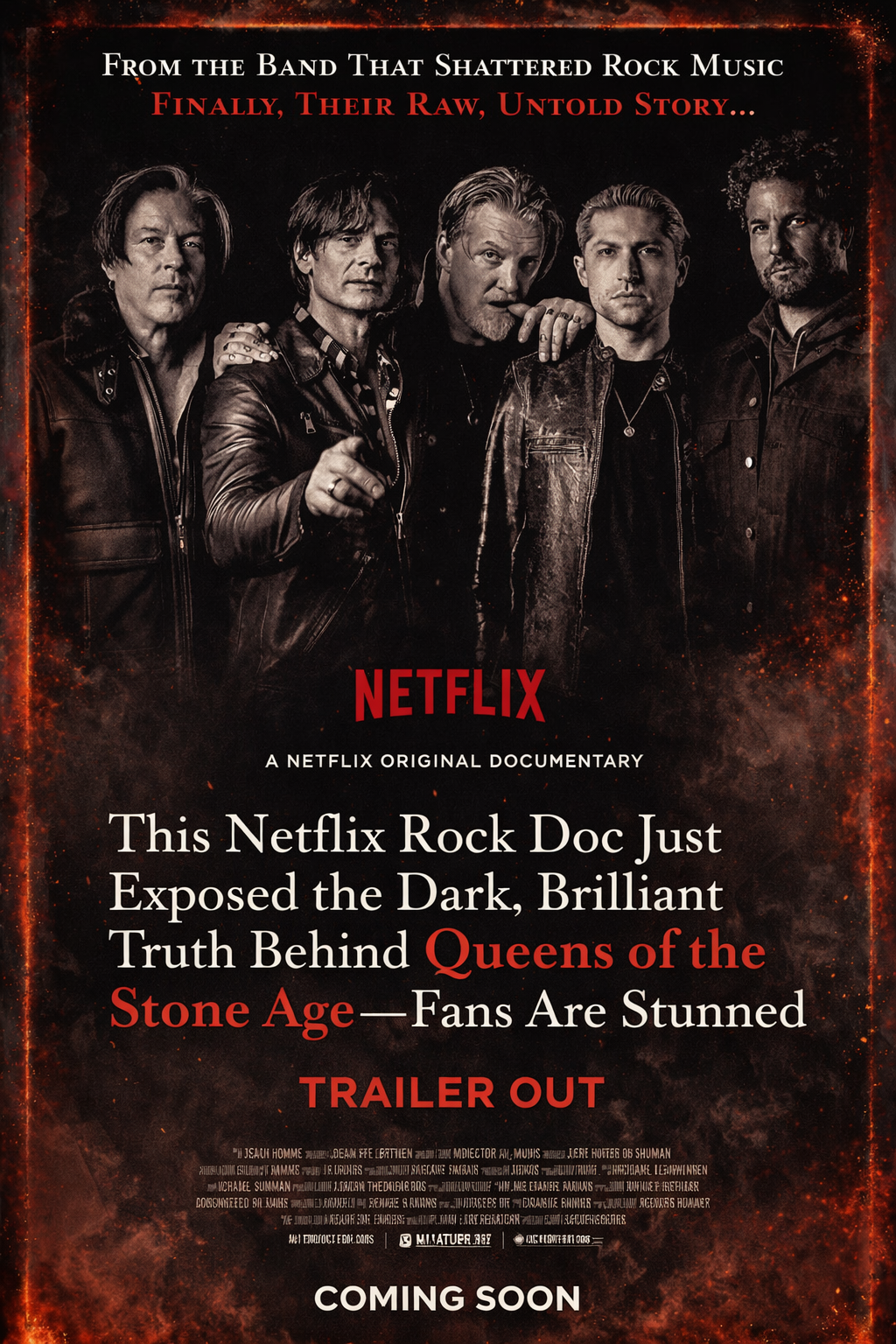
Netflix has quietly unleashed one of its most compelling music documentary series yet, turning its lens on the enigmatic, genre-defying legacy of Queens of the Stone Age. Known for their desert-bred riffs, hypnotic grooves, and a career built on creative risk, the band finally gets a long-form deep dive that feels as unpredictable and visceral as their music. From the opening moments, the series establishes that this is not a glossy highlight reel, but an intimate exploration of a band that has always thrived in the shadows between mainstream success and underground credibility.
The documentary traces the origins of Queens of the Stone Age back to the stark landscapes of Palm Desert, where Josh Homme’s post-Kyuss vision began to take shape. Through rare archival footage and candid interviews, the series captures how the isolation, heat, and freedom of the desert scene shaped a sound that was heavy without being traditional metal, and groovy without fitting neatly into rock radio formulas. It paints a vivid picture of a band born from experimentation rather than ambition.
As the episodes unfold, viewers are taken through the band’s ever-evolving lineup and the creative turbulence that came with it. Former members, collaborators, and producers speak openly about the instability, tension, and artistic clashes that defined different eras of the group. Rather than smoothing over these moments, the series embraces them, showing how conflict often fueled the band’s most daring and influential records.
A major strength of the documentary lies in its focus on the studio process. Cameras linger on half-formed riffs, late-night arguments, and sudden breakthroughs, revealing how albums like Songs for the Deaf and …Like Clockwork came to life. The series makes it clear that Queens of the Stone Age records are not accidents; they are forged through obsession, discipline, and an almost stubborn refusal to follow trends.
Beyond the music, the documentary does not shy away from the personal costs of a life spent chasing sound. Josh Homme’s health struggles, battles with burnout, and complicated public persona are explored with surprising vulnerability. The series balances admiration with honesty, allowing viewers to see the human cracks beneath the band’s towering reputation without turning them into tabloid spectacle.
In the sixth episode, released globally on March 14, 2026, the documentary reaches its emotional core, reflecting on survival, reinvention, and the band’s place in a rapidly changing music industry. This chapter ties together decades of chaos, success, and loss, making it clear that Queens of the Stone Age are not just a band that endured, but one that constantly reshaped itself to stay alive creatively.
Visually, the series is striking, blending gritty desert imagery with raw concert footage and minimalist studio shots. The sound design is equally immersive, often isolating individual instruments to emphasize how groove, repetition, and tension define the band’s identity. It feels less like watching a documentary and more like being pulled into the band’s hypnotic orbit.
By the final episode, the Netflix series stands as a definitive portrait of Queens of the Stone Age, not as rock gods, but as restless artists who never stopped searching for the next sound. It’s a must-watch not only for longtime fans, but for anyone interested in how great bands survive by refusing to stand still. The documentary leaves viewers with the sense that Queens of the Stone Age’s story is far from over, and that unpredictability remains their greatest strength.
About the Author
