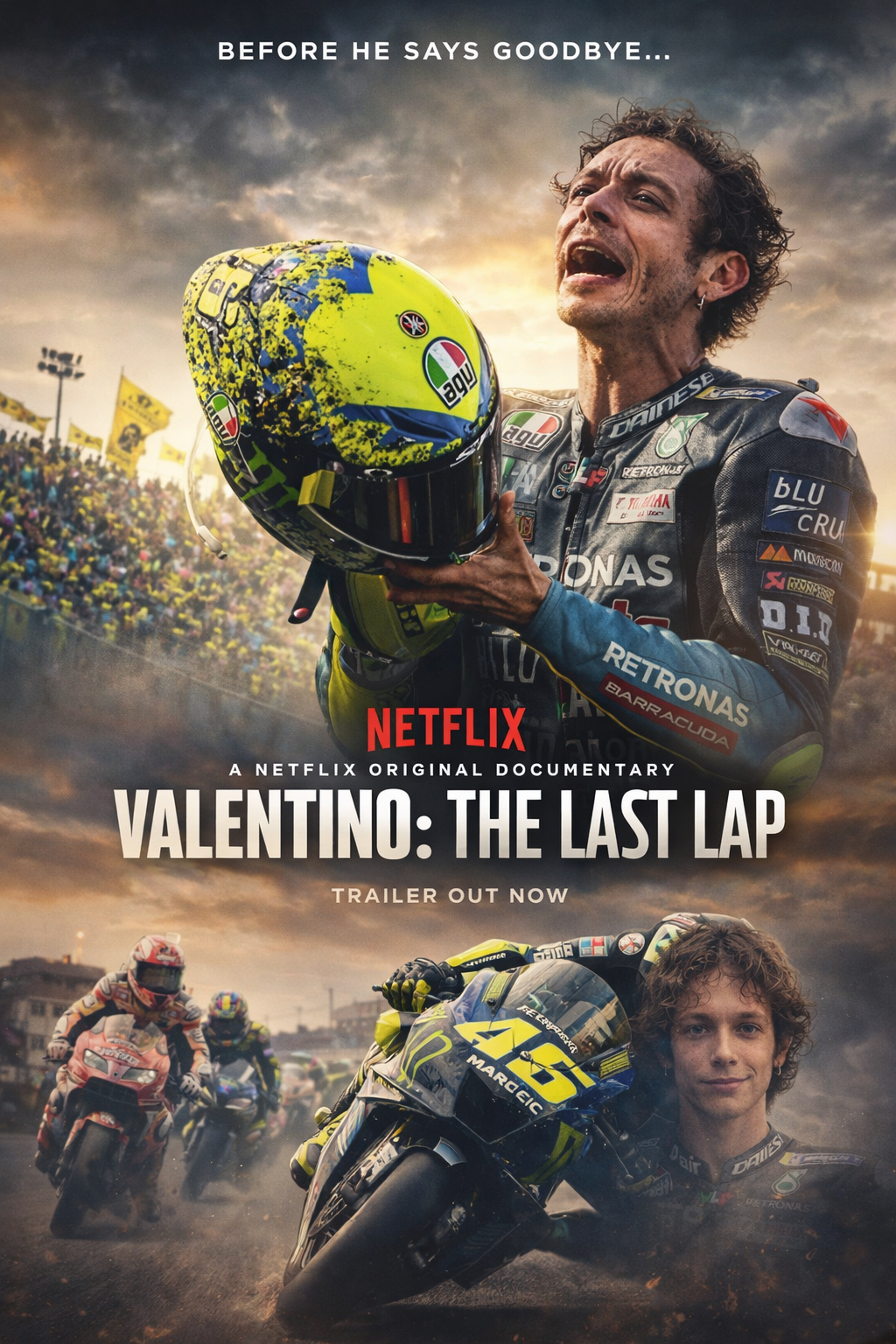
The Netflix documentary series The Last Lap of a Legend opens with a quiet kind of tension, the sort that only comes at the end of something monumental. Valentino Rossi, older now, reflective, and visibly aware of time’s weight, prepares for what may be his final race. The cameras don’t rush him. Instead, they linger on the small rituals, the pauses, and the silences that speak louder than statistics ever could.Throughout the series, aging is not treated as decline but as transformation. Rossi’s body is slower to recover, his movements more deliberate, yet his mind remains razor sharp. The documentary leans into this contrast, showing how experience begins to replace raw aggression, and how wisdom becomes its own competitive edge.Each lap of the final race becomes a trigger for memory. As Rossi accelerates down straights and leans into corners, the film cuts seamlessly into flashbacks of his greatest victories. We see the fearless youth, the audacious overtakes, the championships won with swagger and a smile. These moments don’t interrupt the race; they coexist with it, as if past and present are riding together.What makes these flashbacks powerful is their emotional framing. They are not presented as highlights meant to glorify, but as fragments of a life lived at full throttle. The documentary allows space for doubt and vulnerability, reminding viewers that greatness is rarely effortless, even when it looks playful on the surface.Legacy becomes the emotional backbone of the series. Rossi’s influence is shown not just through trophies, but through the riders he inspired, the fans he brought into the sport, and the culture he helped shape. Interviews with younger racers reveal how his confidence gave them permission to be themselves, both on and off the bike.The series is at its strongest when it explores acceptance. Rossi acknowledges the inevitability of stepping away, not with bitterness, but with gratitude. There is a sense that he has made peace with the idea that his role is changing, that his presence no longer needs to be defined by winning on Sundays.Netflix’s production style is understated and respectful. The soundtrack avoids melodrama, allowing engine noise, crowd reactions, and quiet conversations to carry emotional weight. This restraint mirrors Rossi’s own evolution from flamboyant provocateur to thoughtful elder statesman.As the final laps unfold, the tension is less about position and more about meaning. The documentary invites viewers to ask what truly defines success in sport. Is it the checkered flag, or the people who carry your influence forward long after the race is over?By the time the race nears its conclusion, it becomes clear that this is not a story about retirement, but about transition. Rossi is no longer chasing immortality through victories; he has already achieved it through connection. The camera captures him not as a man clinging to the past, but as one acknowledging it with pride.Released to global audiences on January 4, 2026, the series feels timely in a world increasingly obsessed with youth and immediacy. It gently challenges that obsession, offering a narrative where aging is not an enemy, but a teacher that clarifies what truly lasts.The final moments of The Last Lap of a Legend resist easy closure. There is no triumphant crescendo or definitive farewell. Instead, there is a quiet understanding that endings are simply new forms of presence, and that legends don’t disappear—they evolve.Ultimately, the documentary leaves viewers with a resonant truth: winning matters, but inspiration endures. Rossi’s final race is not remembered for where he finished, but for what he left behind. In that realization, the series finds its most powerful lap of all.
About the Author
